
Table of Contents
Introduction
An unexpected refrigeration collapse on a Friday night during peak harvest season turns any facility manager’s worst nightmare into reality, proving that an industrial building hvac electrical plumbing design failure in food processing plants can destroy millions of dollars in inventory within hours. When processing lines run at 100 percent capacity, marginal engineering assumptions collapse under real-world thermal and electrical loads.
MEP Integration Fundamentals in Food Facilities
Food processing environments demand rigorous synchronization between mechanical, electrical, and plumbing infrastructure. HVAC systems must maintain precise psychrometric conditions to prevent condensation and bacterial growth. Meanwhile, electrical networks must supply continuous power to heavy refrigeration compressors, and plumbing systems must safely manage high-temperature sanitation cycles. However, designers often treat these trades as isolated systems instead of an interdependent organism. Therefore, when steam demand spikes, boiler feed pumps draw excess electrical current, triggering upstream transformer protection relays if the demand factor miscalculation was overlooked during the initial phase of industrial building hvac electrical plumbing design failure in food processing plants.
Peak Load Operational Realities
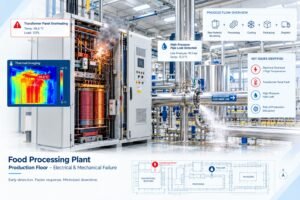
During maximum output cycles, latent heat loads from cooking vats collide with extreme sensible heat loads from washdown operations. Standard baseline calculations fail to account for simultaneous peak usages. Consequently, chilled water supply temperatures drift upward by 4°C, pasteurization units trip on high-head pressure, and washdown drainage overflows because pipe friction loss calculations ignored simultaneous waste discharge coefficients. These cascading anomalies quickly transform minor engineering oversights into catastrophic plant shutdowns.
Multidisciplinary Failure Modes
Failure rarely happens in a single discipline. Instead, it ripples across the entire utility matrix.
HVAC Vulnerabilities
Undersized air handling units fail to maintain positive pressure in packaging rooms, drawing contaminated air from washdown zones and causing immediate micro-biological batch rejections.
Electrical Shortfalls
A transformer loading error occurs when harmonic distortions from variable frequency drives (VFDs) on refrigeration compressors overheat dry-type transformers, causing unexpected thermal overloads during peak summer ambient temperatures.
Plumbing Bottlenecks
Inadequate grease trap sizing combined with sharp drainage bends causes severe backflow during peak shift clean-in-place (CIP) procedures, violating strict sanitary compliance mandates.
Financial Impact of System Shutdowns
Financial Breakdown of a 12-Hour Peak Production Halt
- Spoiled Raw Material & WIP Inventory: $180,000 – $350,000
- Emergency Contractor Callout & Overtime Labor: $25,000
- Retail SLA Penalty Fines: $50,000
- Lost Manufacturing Output: $120,000
- Total Estimated Loss Per Incident: $375,000 – $545,000
Step-by-Step Engineering Method
To eliminate systemic risks, plant developers must implement a rigorous forensic engineering workflow. First, audit all connected electrical loads against actual sub-metered peak consumption data. Next, run computational fluid dynamics (CFD) models on refrigeration distribution loops. Finally, recalculate all hydraulic networks to verify that pipe friction loss does not starve remote clean-in-place skids of required water velocity.
Engineering Calculation & Sizing
Evaluating fluid transport efficiency requires accurate friction loss computation using the Darcy-Weisbach equation:
h_f = f * (L / D) * (v^2 / (2 * g))
Where:
- h_f = Head loss due to friction (m)
- f = Darcy friction factor (0.018 for sanitary stainless steel tubing)
- L = Equivalent pipe length (120 m)
- D = Internal pipe diameter (0.1016 m / 4 inches)
- v = Flow velocity (2.5 m/s)
- g = Acceleration due to gravity (9.81 m/s²)
Plugging in the parameters: h_f = 0.018 * (120 / 0.1016) * (2.5^2 / (19.62)) = 0.018 * 1181.1 * (6.25 / 19.62) = 132.6 * 0.318 = 42.17 meters of head loss.
If pump selection fails to account for this 42.17m head loss plus dynamic elevation changes, flow rates drop by 30%, directly triggering thermal cutouts on pasteurizer heat exchangers.
Design Best Practices
Mitigating future design risks requires strict adherence to international engineering guidelines. Maintain a minimum 25% safety margin on all step-down transformers to absorb VFD harmonics, as outlined in NFPA 70. Ensure all refrigeration piping adheres to ASHRAE refrigeration plant safety codes. Furthermore, size all process drainage mains in compliance with IPC standards, ensuring a minimum 2% slope for solid-bearing wastewater lines.
Regulatory Standards
Engineering compliance must align with established global frameworks:
- ASHRAE Handbook – Refrigeration: Governs cold storage thermodynamic loads and secondary coolant safety.
- NFPA 70 (NEC): Regulates industrial electrical installations, ampacity sizing, and harmonic mitigation.
- International Plumbing Code (IPC): Dictates sanitary drainage sizing, backflow prevention, and grease interceptor standards.
Conclusion & Call to Action
Preventing an industrial building hvac electrical plumbing design failure in food processing plants requires multidisciplinary foresight, rigorous mathematical validation, and deep industry expertise. Don’t wait for your next peak production cycle to expose hidden design flaws. Partner with A-Square MEP Consultants today to conduct a comprehensive thermal and electrical audit of your processing facility. Contact our senior engineering team to schedule your plant health assessment.
Frequently Asked Questions
Why do electrical and HVAC systems fail simultaneously during peak food production?
Simultaneous peak loads create compounded thermal and electrical stresses. Refrigeration compressors draw maximum current while ambient heat loads spike, triggering transformer overloads and mechanical trips if diversity factors were incorrectly calculated.
How does pipe friction loss impact food plant sanitation cycles?
Excessive pipe friction reduces fluid velocity and pressure at remote clean-in-place (CIP) stations. This prevents chemical sanitizers from achieving the required turbulent flow (Reynolds number > 4000) needed for effective bacterial removal.